Research is organized by questions—not by making every finding look like a film version.
The current reviewable release is V49. The next release is measurement-dependent: it will be numbered only after a new measurement or verifiable correction. The current engine is V49 conservative common-density Kodak 5279 / 2383 baseline. Legacy internal V47–V86 labels remain immutable experiment IDs for scripts, reports and failed experiments.
Material measurement and data authority
Re-read the public 5279 and 2383 records, separating source measurements, vector extraction, interpolation and inference while registering Status-M, net dye density, D-min and granularity in their proper coordinates.
CURRENT CONCLUSION: Public evidence constrains the three marginal RMS curves and spectral shapes, but not a complete 5279 NPS, cross-record spectra or proprietary formula.
Open traceable experiment appendix
Multilayer development, grain and joint statistics
Separated grain amplitude, spatial spectrum, fast/mid/slow populations, DIR reaction–diffusion and cross-record covariance, then tested finite events against nonnegative density and the public 48 µm marginals.
CURRENT CONCLUSION: Shared events are not free chroma cleanup: they trade opponent energy for stronger luma grain. No correlation coefficient is selected without cross-spectral evidence.
Open traceable experiment appendix
Grain-structure boundary
Separated amplitude, spatial correlation, population size and inter-record statistics; the public record does not disclose a complete 5279 NPS.
Density-formation boundary
Random events must participate in dye-density formation rather than being added after display RGB; every candidate must re-close the published RMS.
Grain–sharpness coupling
Sharpness and grain cannot be tuned independently: MTF, dye-cloud spectrum and observer aperture jointly determine the 35 mm scale impression.
Common-density public correction
Removed V48's display-RGB residual reinjection and publishes only a symmetric common density inside the formed negative before direct 2383 and scan observation.
Cross-record covariance ownership
Proved that the public 48 µm curves constrain only covariance diagonals; cross-power spectra among red, green and blue records remain unmeasured.
Record-coupling audit
The existing direct record-mix operator lacked 5279 evidence and altered measured marginals, so it was withdrawn.
Evidence-minimal record formation
Internal baseline inherited by public V46: identity record formation preserves H-D, DIR, MTF and each record's 48 µm RMS without pretending the cross-covariance is known.
DIR-topology identifiability
The public record supports DIR and its direction but cannot uniquely identify 5279's layer-to-layer kernels, ranges or strengths.
Population activation and native NPS
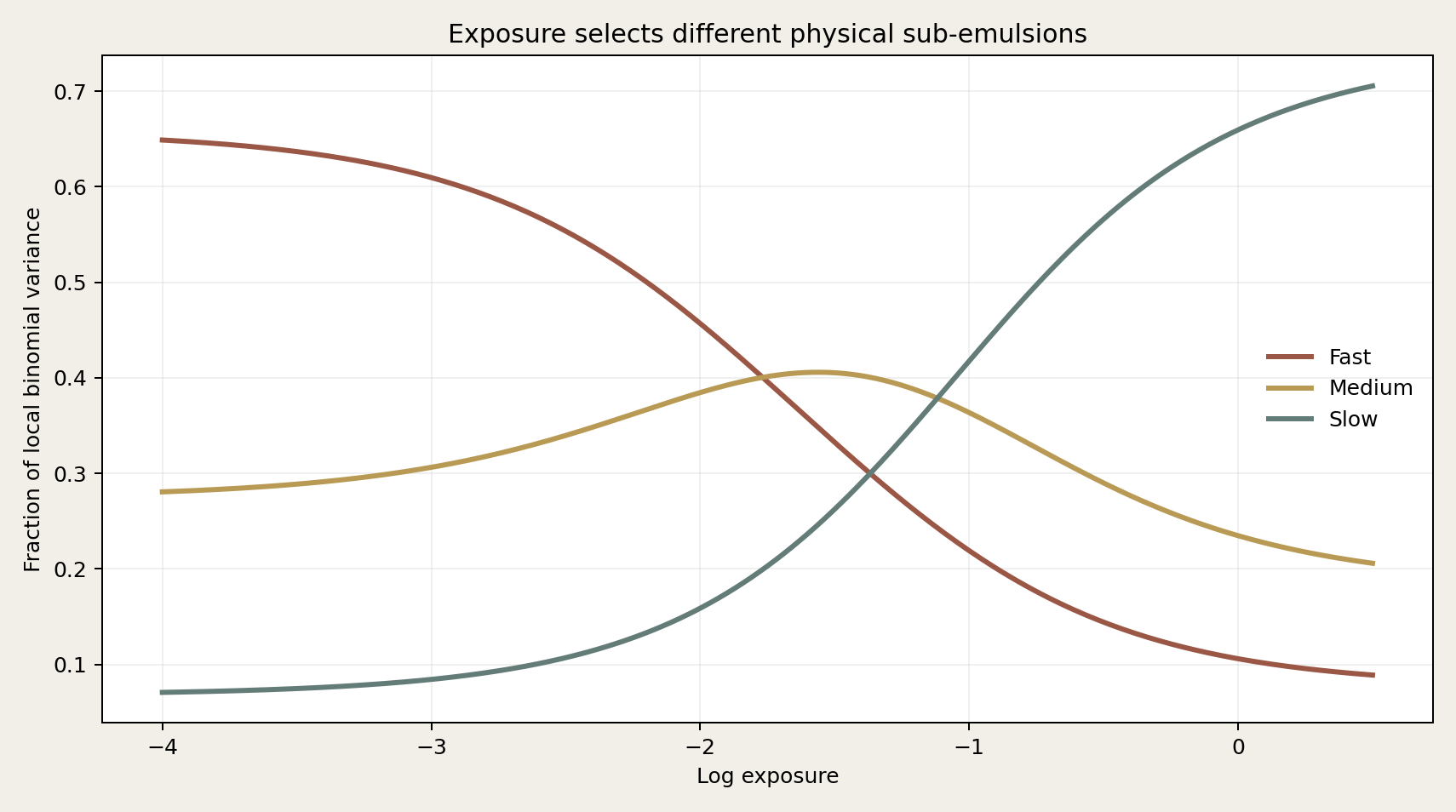
Fast, medium and slow population activation changes with exposure; one fixed noise spectrum cannot span toe, mid-scale and shoulder.
Cross-record covariance bounds
Even with every 48 µm marginal RMS closed to 5.28×10⁻¹⁰, post-formation 3×3 covariance mixing changes luma, breaks tails and creates about −0.60 D density, so it is rejected.
Shared finite-event Bernoulli bounds
Derived exact Fréchet bounds: while preserving Bernoulli marginals, ρ=.99 is feasible in only 13 of 180 record/population/exposure cases. Any next model must use bounded shared events before density formation.
Three-record Bernoulli compatibility
Pairwise validity and a PSD correlation matrix are still insufficient: 3,462 of 7,500 independent pair-parameter sets have no nonnegative eight-cell RGB law, including 1,484 PSD false positives. The single-common-alpha family is valid mathematics, not a measured 5279 coefficient.
Shared-event DIR/RMS closure
Corrected our own description: V72 actually inherits post-DIR residual calibration, not pre-DIR dye-yield calibration. The only legal shared-event family remains within 1.08% of the public 48 µm RMS at every alpha/exposure endpoint after five-class formation and stochastic DIR, yet the same marginals permit near-zero to roughly 0.7–0.95 record correlation and cannot select alpha.
Shared sites are not free chroma cleanup
A paired real-RAW crop shows alpha 0→1 lowers opponent RMS 16–18% but raises luma grain 43–54% and total RGB grain 23–26%, with no common projection/scan balance point. Alpha=1 is rejected as a default; .25/.50 remain diagnostics while the large official blue-record marginal and its visible-colour mapping are re-audited.
2383 printing and cinema observation
Traced printer light, LAD, 2383 H-D and dye spectra through xenon, the CIE observer, projection flare and display companions, removing duplicate density shaping and ownership errors.
CURRENT CONCLUSION: 2383 material response and a period cinema result are not the same identifiable quantity; illuminant, batch, printer control and viewing conditions must be declared separately.
Open traceable experiment appendix
2383 characteristic audit
Reconstructed public 2383 record curves and audited printing-exposure coordinates and neutral calibration.
2383 spectral-vector extraction
Re-extracted 2383 dye-density and xenon plots from the 2005 data while preserving their original 20 nm information limit.
2383 spectral-integration audit
Checked spectral interpolation, observer integration and white normalization; a denser integration axis cannot invent unpublished material detail.
Projection-colour identifiability
Public 2383 curves alone cannot uniquely recover a period theatrical colour result; illuminant, batch, printer control and viewing conditions remain unknown.
Memory-fit projection colour rejected
Several plausible projection colours satisfy the limited evidence, so selecting one by taste and calling it 5279 truth is rejected.
Integral LAD coordinate
Anchored 2383 printing exposure to an integral LAD coordinate so single-wavelength or display-RGB proxies cannot silently alter print density.
Visual-neutral base spectrum
Audited the D-min base spectrum under xenon and the standard observer; material base spectrum is not the same thing as display black.
D-min coordinate registration
Registered 2383 minimum density, curve origins and spectral base in one coordinate, eliminating double addition or subtraction of base density.
Interimage stage and observer lattice
Separated ownership of DIR interimage development, negative dye density, 2383 printing and the observer lattice to prevent double-counting colour effects.
2383 neutral trajectory
Traced the neutral axis through printing exposure and found historical management policy inside the current projection colour—not only 2383 spectra.
Duplicate density shaper removed
Removed an empirical density shaper applied after the public 2383 curves; this was an image correction inherited by later releases.
Projection-observer ownership
Separated negative, print, projection light, display transform and web companion; the observer is no longer treated as an emulsion parameter.
Frequency ownership and projection grain
Separated scene colour from stochastic opponent colour and corrected an older gate that could misclassify real detail as colour noise.
Projection grain-policy ownership
The two-stage projection opponent management is historical defect containment, not a 5279/2383 measurement. Removing it raises isolated dark opponent events from 1 to 215, 4,275 or 402,394.
Scan, DI and home-video delivery
Layered negative scanning, Cineon/DPX, display transforms, scale integration, still authority and encoding. The 5.7K raster is an internal reconstruction/DI master—not a Blu-ray deliverable.
CURRENT CONCLUSION: The next visual release will derive separate Blu-ray and UHD witnesses from one Scan/DI master, declaring resolution, 4:2:0, bit depth, range and AVC/HEVC compression; an HDR remaster is not assumed.
Open traceable experiment appendix
Cineon printing-density coordinate
Re-audited the scan branch's Cineon/printing-density coordinate and added native-frame opponent-grain gates.
Cineon display-layer ownership
Separated DPX/Cineon code values, display conversion and creative grading; the baseline owns only a declared viewing chain.
DPX and profile isolation
Verified that scan masters, display companions and experimental profiles cannot share unversioned caches or hidden parameters.
Named Cineon view policy
Made Cineon display and grain management explicit named policies with provenance so delivery adapters cannot masquerade as film physics.
Scale-integration boundary
Native 5.7K, 2K integration and player scaling must remain distinct; sharp resizing can fold above-Nyquist structure into coarse grain.
ProRes XQ codec audit
Audited the 12-bit master and review derivation; stills must come from the final movie, not a pre-encode cache.
Frequency ownership and projection grain
Separated scene colour from stochastic opponent colour and corrected an older gate that could misclassify real detail as colour noise.
Uniform-field codec NPS
Measured uniform-field spectra before and after encoding; ProRes XQ is not the main cause of the observed scale change.
Do not denoise RGB—prevent the wrong RGB noise from forming
V48's deterministic 2383 mean was correct, but it still took a formed-minus-mean residual from a different managed observer graph and added it back in display RGB. A mean and residual from two observer graphs do not form one physical picture; isolated red, green and blue shadow points were the result. V49 deletes that reinjection.
Kodak publishes three marginal 48 µm Status-M RMS curves, not cross-record covariance or cross-spectra. V49 therefore does not invent a coloured joint law. The symmetric common component cannot exceed any published marginal; unallocated opponent variance remains explicit uncertainty. On the paired T020 crop, projection luma residual RMS moves from 0.001319 to 0.001264 while opponent RMS falls from 0.001313 to 0.000489 and p99.9 from 0.007644 to 0.002182. This is a density-formation correction, not display denoising.122570
One negative, two observers
V48 gives the direct 5279-to-2383-to-xenon/CIE integration ownership of the projection mean; old V46 management contributes only the formed-minus-mean stochastic delta. RAW, negative, H-D, DIR, MTF, 48 µm RMS, 2383 and scan are frozen.
Strength, scale, clustering, tails and local heterogeneity must pass together
V47 does not merely make grain “more complex.” A controlled local Nik 8 export turns Kodak Tri-X 400 RMS, lag-1, skew and excess kurtosis across sixteen flat-field tones into explicit acceptance targets. Matching RMS and radius alone no longer passes. The first candidate had near-zero formed-density kurtosis; although its still looked fine, it remained too orderly and its 24-frame render was stopped.
Accepted SHM measures shadow/mid/highlight lag-1 of 0.3795/0.3860/0.3914, skew of 0.1261/0.1334/0.1373 and excess kurtosis of 0.3034/0.2809/0.2610. Its midtone RMS is 0.014315 against 0.014309 measured. The opponent-colour field remains deterministic and randomness changes one density axis, so the model cannot reintroduce independent RGB speckles. V46 retains the three-record 5279 negative, DIR, MTF and both observers; V47 changes only the independent comparator morphology.12558636572
Endpoint-stable finite events and an exact nonnegative spectral inverse
V46 corrects two defects that genuinely change pixels. First, the former stochastic formation held target RMS beyond Kodak's published granularity curves while finite-site activation probability approached zero, allowing extremely rare but enormous density impulses. V46 does not merely clip an output. It holds the complete probability, calibration-amplitude and population-weight state at measured-support endpoints. Second, the clipped iterative Status-M-to-negative-dye inverse did not guarantee the nonnegative least-squares optimum. V46 enumerates active sets and certifies them with KKT conditions.
Every real T020, T032 and T007 pixel is tested before/after MTF and in mean/formed density states. All 25,333 demanded risk cells are present, with zero full-pipeline misses. Independent 6,000-point exact checks per state measure a worst printer-density error of 0.0005094 D, below the 0.001 D release gate. The compiled runtime disables fast-math and is bit-identical to the NumPy reference. Projection and scan share one negative printer-density observation; their differences begin only after the common negative.
This does not fill proprietary unknowns. V46 retains evidence-minimal identity record formation rather than inferring RGB cross-covariance from three 48 µm marginal RMS curves. V79 projection-opponent management remains explicitly frozen as historical defect containment, not represented as measured 5279/2383 physics. Legacy internal V46–V86 IDs remain unchanged to show where this consolidation came from and which candidates were rejected.142148
Full methods and experiment archiveEquations, image evidence, rejected candidates and legacy experiment IDs remain intact, but stay collapsed so each note is not mistaken for a release.
Unknown covariance can trade away chroma noise, but a more basic shadow-spectral precision defect comes first
V86 fixes Kodak's three 48 µm Status-M RMS marginals and lets the 3×3 correlation matrix vary over the complete positive-semidefinite unit-diagonal domain. Between −3.0 and −0.5 logE, fully common positive events usually raise luma RMS to 1.48–1.67× independent records while minimizing opponent RMS. This is not free denoising: record-difference energy becomes common density fluctuation. Maximum-opponent endpoints often require negative or alternating correlations that may fail the V81–V83 finite-event and DIR gates.
The observer audit exposes a firmer error. The joint Status-M-to-2383-printer-density spectral LUT is only 29³, with 0.1 D cells; the later 193³ monitor lattice has 0.0154167 D cells. Both are continuous trilinear interpolation, not code-value quantization, but the downstream lattice cannot restore curvature already lost upstream. Running V61's joint spectral integration directly gives a runtime error of (+0.01101,+0.00767,+0.00237) D at the neutral −3 logE point, with a +0.013987 D worst case. From −2.5 to 0 logE the error stays below 0.000366 D.
- Do not select covarianceThe outer envelope measures the unknown's influence; it does not identify 5279's joint law.
- Shadow error locatedThe defect is concentrated in the toe; it does not invalidate the whole mid-scale colour model.
- V87 precision gateReplace or densify the 29³ joint spectral stage, hold shadow and mid-scale printer-density error below 0.001 D, then compare all three branches on identical source frames.
The large blue marginal was not copied incorrectly; the unknown is how the three records fluctuate together
V85 retrieves the same-SHA March 2003 H-1-5279t used by V50, renders printed pages 3 and 4, and reads the vector objects in F002_0269AC directly. The red path spans three objects while green and blue use one each; all twelve logarithmic Sigma-D ticks are fitted again. The new extraction differs from the versioned CSV by at most 2.885×10⁻⁶ D (0.0152%), confirming both R/G/B identity and the larger blue-record marginal.
After translating the combined graph's 0—4 horizontal coordinate to the separate graph's −4—0 logE, the companion R/G/B H-D curves differ by only 0.01261/0.01134/0.01089 D RMS. That agrees with Kodak's note that sensitometry and granularity were produced on different equipment. ISO 10505 further requires ISO 5-3 Status-M spectral products and a 48.0±0.5 µm circular aperture for colour-negative RMS granularity. V50's values, the exposure translation and V61's joint Status-M inverse are therefore retained.
- Curve identity passesChannel swapping or lowering blue RMS cannot be called a correction.
- Exposure coordinate passes0—4 to −4—0 is a translation of the same four-logE domain.
- Status M passesV61+ jointly inverts through D-min and all three net dye/mask spectra.
- Bound the next unknownWithout a 5279 cross-spectrum, derive observer-space limits over all physically legal covariance before selecting any alpha.
Shared sites can reduce the colour-noise impression by turning it into stronger luminance grain
V83 proved only that the common-alpha family can preserve three 48 µm marginals. V84 takes a native 576×576 crop from T020 frame zero and makes alpha=0/.25/.5/1 consume the same selector, common U and three independent U values. Mean, probabilities, all 45 spatial kernels, DIR and observers are frozen. The four deterministic projection/scan pairs are pixel-identical, so every visible change belongs to the joint finite-event law.
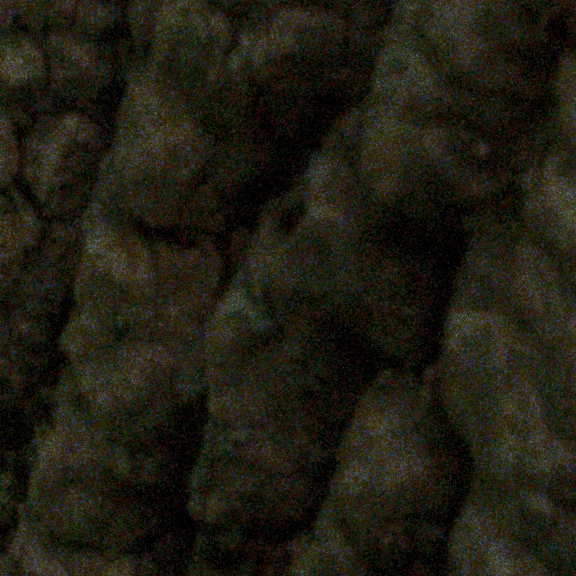
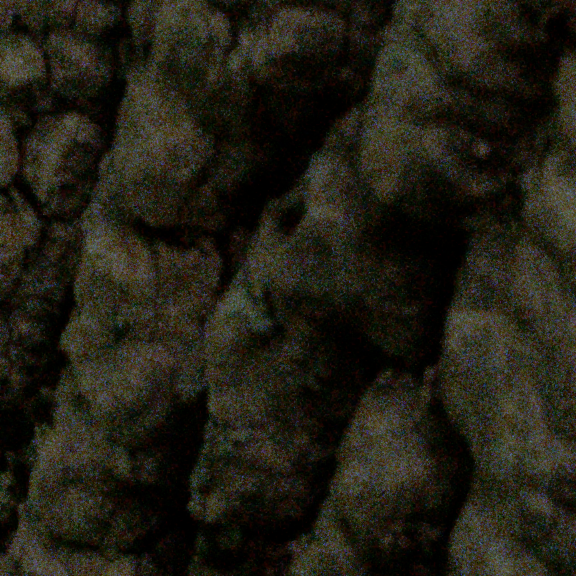
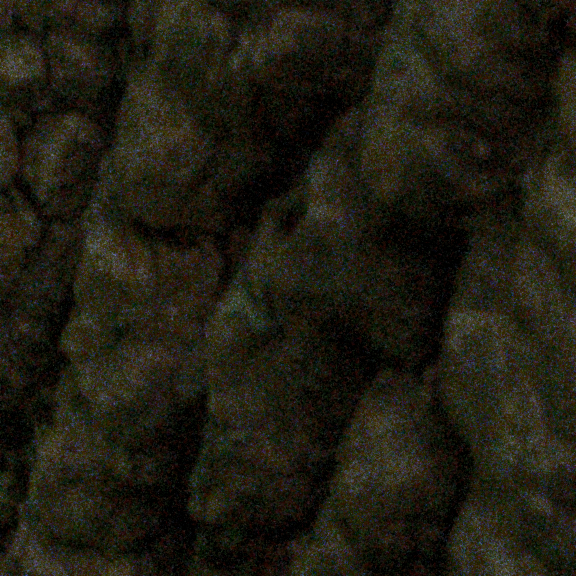
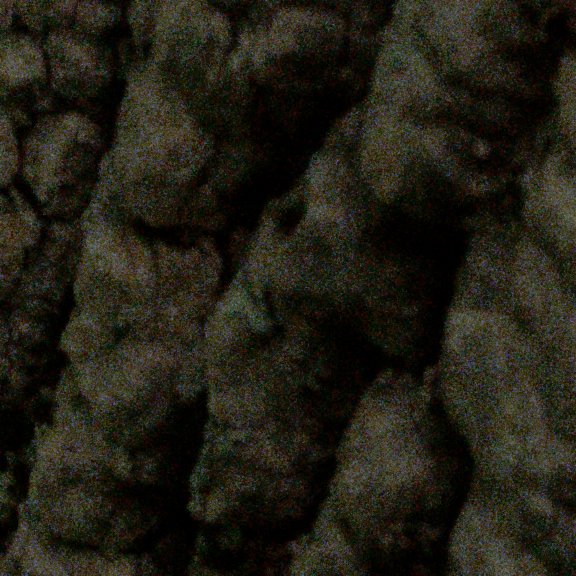
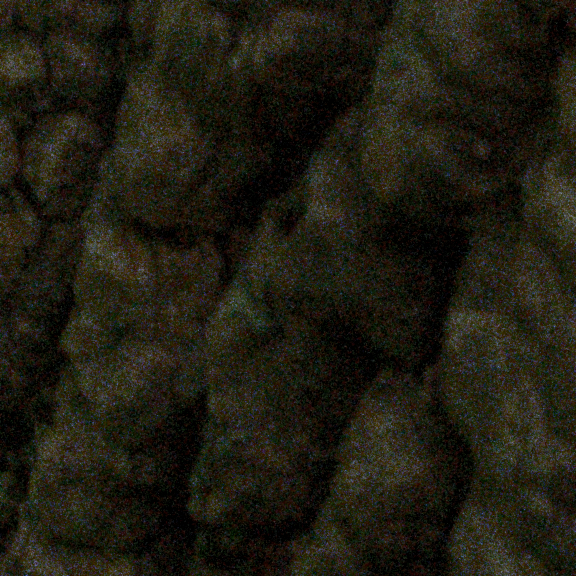
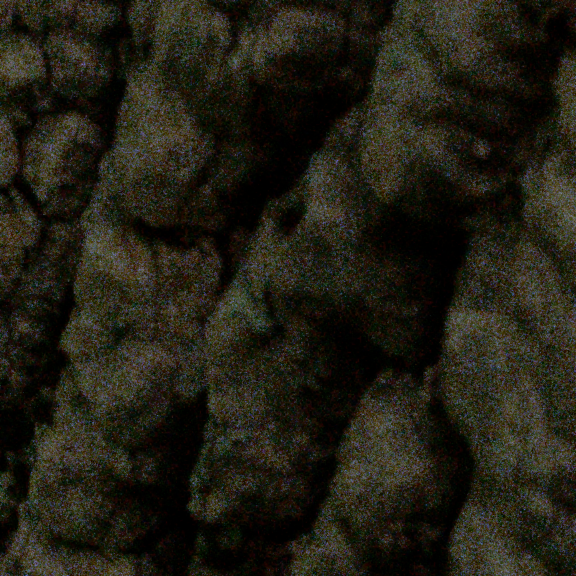
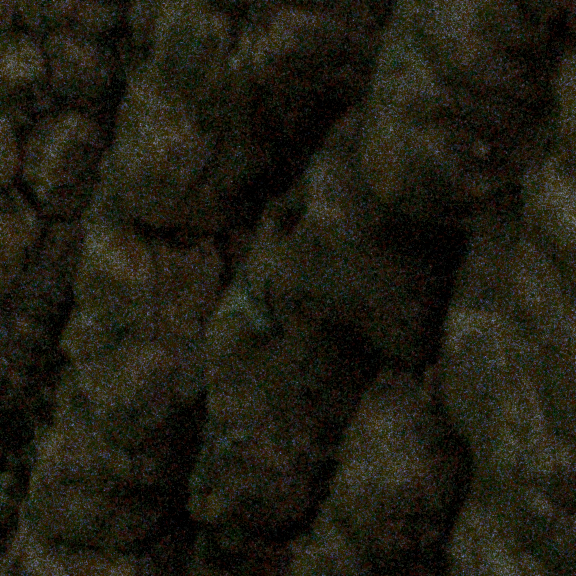
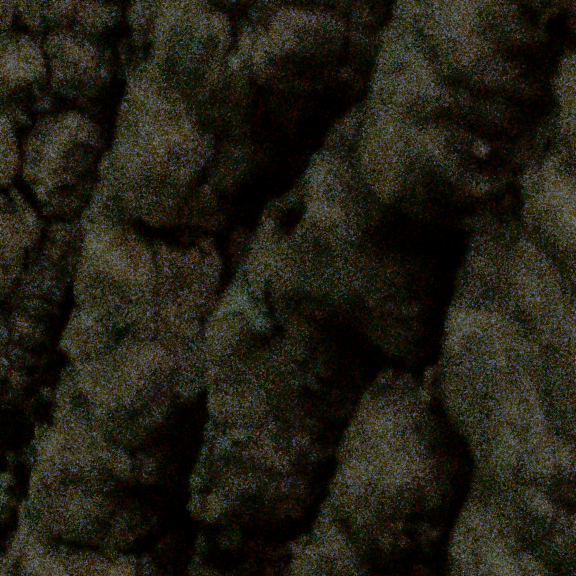
Alpha 0→1 lowers projection/scan opponent RMS by 16.3%/18.4%, but raises luma RMS by 53.8%/43.2%; total RGB grain still rises 25.6%/23.3%. It does not remove noise—it changes the covariance combination seen by each observer. Alpha .25 or .5 happens to put one branch near a ratio of one, but projection and scan have no common balance point and no official target defines “balanced.”
- Reject alpha=1 as defaultA near-common site lattice is unmeasured and raises total visible grain by about one quarter.
- Keep .25/.50 diagnostic onlyA more balanced appearance is not material evidence.
- Scale does not erase itExact 3×3 integration retains roughly 51–56% of the differing luma/opponent RMS.
- Return to the public graphThe crop's blue 48 µm record RMS is about 3.86× red and 2.59× green. Recheck legend, Status-M meaning and visible-colour mapping before compensating it with unknown covariance.
Three correct marginal RMS values still cannot tell us how colour grain should move together
Re-executing the full profile inheritance chain first corrected an error in our own description: active V72 inherits V40's post_coupling_residual mode, not V39's pre-DIR dye-yield calibration. Its gain is applied to the record residual after stochastic DIR, while the denominator remains the independent pre-DIR 48 µm variance prediction. V83 does not rewrite that historical implementation. It reproduces the executable path literally and then audits the missing cross-record terms.
The only jointly legal V81/V82 common-alpha event then enters the actual three-record × fast/medium/slow × five-size-class spatial model and passes through three diffusion lengths, intralayer high-pass inhibition and interimage low-pass DIR. All 20 exposures and alpha=0/.25/.5/.75/1 pass the ±5% pre-render gate; the maximum departure from Kodak's 48 µm RMS is 1.076%. A separate exact finite sampler verifies 331,776 interior Bernoulli/multinomial samples per endpoint, agreeing with the analytic integral within 1.110% RMS and 0.034 correlation.
The important result is that passing does not identify alpha. At −2 logE, alpha=0 gives nearly zero record correlation while alpha=1 gives rhoRG=0.954, rhoRB=0.847 and rhoGB=0.809; full sharing spans about 0.714–0.954 over key exposures. Both extremes satisfy the same Kodak marginal RMS. This explains why earlier versions could carry the correct quantity of grain yet resemble electronic colour noise: the published graph constrains only the covariance diagonal. V83 authorizes labelled uncertainty renders, not a new 5279 coefficient, and changes no V72 pixels.
- Correct the fact firstCurrent V72 is post-DIR residual calibrated; the old description is withdrawn.
- Verify finite eventsNo completed-density 3×3 mix and no Gaussian surrogate.
- Marginals are not the joint lawThe same official RMS admits near-independent through near-common colour structure.
- Uncertainty comparison onlyThe next render must report covariance, tails and scale integration; taste cannot select alpha.
The observer can become more accurate without rewriting the emulsion
V44 and earlier sampled a smooth analytical CIE 1931 approximation directly at the Kodak 2383 graph's 20 nm nodes. That was useful for an early prototype but is not the standard-observer data published by the CIE. V45 loads the official 360–830 nm, 1 nm table and integrates over 380–780 nm, the range supported by the 2383 graph. Kodak dye-density and xenon relative-SPD samples retain their public 20 nm information and are only linearly interpolated; no higher-resolution material measurement is invented.46869
This is a single-variable revision. The 5279 H-D curves, nine speed populations, DIR, MTF, 48 µm RMS, grain timing, coloured mask, input colour, period scan, black, contrast, gamma and both deliveries are frozen. Across the complete 25³ spectral cube, linear-RGB RMS versus the old observer is 0.00456917 and maximum node change is 0.0398455. Dye-free white changes by less than 4×10⁻⁷, so this is not a hidden white-balance adjustment.
The implementation audit found that release rendering reads a precomputed 193³ lattice. Changing only the integration function while loading the V30 lattice would produce a code revision with completely unchanged images. V45 therefore generates a separate lattice and binds the profile, CIE table and lattice by SHA-256; startup fails if any authority drifts. The one-nanometre observer is standard data, but the 2383 curves remain public graph samples—not a same-batch print measurement.204868
- Change observation onlyNegative formation, scan, grain, black and gamma remain frozen.
- Standard-table authorityUse official one-nanometre CIE data, not an analytical substitute.
- The cache is part of the algorithmBind the 193³ lattice to the profile hash and prohibit silent stale reuse.
- Unknowns remain unknownInterpolation cannot turn a 20 nm Kodak graph into unpublished 1 nm material data.
Coarseness may come from the way emulsion is viewed—not only from the emulsion
V43H looked cheap and coarse during local QuickTime review while its native 5.7K still appeared more natural. Ablation rejected the obvious explanations. Wavefront v0.2 differs from the earlier exact path by only about 0.000366 projection RMS. Disabling speculative 2383 common-density grain moves projection high-frequency RMS only from 0.013498 to 0.013453—about 0.33%. A full formed-density observer raises it to 0.014116, and V42 itself measures 0.013741. V44 therefore refuses to repair the picture by guessing a softer 5279 NPS.
On the same T020 frame at 1920 width, Lanczos raises projection high-frequency energy to 1.71× and scan to 1.21× relative to pixel-area integration. An opaque sharp resize can fold native structure above display Nyquist into coarse false texture. V44 therefore adds a scale-declared review file instead of softening the master. Its still is decoded from the same middle frame of the final encoded movie, not a pre-encode float buffer.
The first V44 candidate disabled the V31 colour boundary and published direct analytical 2383 colour. Its reduced still looked plausible, but the 24-frame native gate measured dark opponent p99.99 at 0.04882 and about 127 isolated >0.06 impulses per million dark pixels; scan passed. The candidate was rejected. Release V44 retains the validated normal-process monitor boundary: 2383 still owns lightness, black, contrast and texture, while period scan supplies only low-frequency dye chroma. Similar branch colour is a declared limit; no unmeasured theatrical colour difference is invented. The V43H negative NPS, Spirit candidate and stochastic 2383 grain remain withdrawn.147825
Walter Volpatto’s practitioner interview reinforces the boundary: a 1990s theatrical print, telecine/tape/Blu-ray transfer and a modern reference still are not one colour target. Projection white point, print stock, scanner, finishing grade and display transfer all change the result. Projector flicker, development unevenness and streakiness may be real parts of a film chain, but without measurement they remain future modules—not effects inserted into an objective baseline.276067
- Negative boundaryRetain accepted V42 H-D, DIR, MTF, 48 µm RMS and the V41 colour input boundary.
- Observer boundaryRetain the normal-process monitor colour that passes native opponent-tail gates; do not claim absolute theatrical colour.
- Display boundaryThe 5.7K master stays authoritative; 1920 review explicitly integrates linear light.
- Unknowns stay zeroStock-specific NPS, Spirit response, 2383 grain, flicker and streaking do not enter baseline without measurements.
“Most likely” can be an experiment; it cannot masquerade as a measurement
Public 5279 data provide processed H-D, MTF, net dye density and 48 µm aperture RMS but no complete NPS. DFT documents a period Spirit xenon source, RGB splitter and three CCD lines but not the actual spectral response. Public 2383 data likewise omit three-record grain covariance. V43H is therefore not a replacement for V42. It is an isolated central prediction for three unknowns: preserve official 48 µm RMS while reducing the negative correlation scale to 0.72 of V42; move the period scanner only 25% toward a synthetic candidate; add only weak, spectrally neutral common-density texture to 2383, with amplitude estimated from the three-record mean.1478255859
Projection and scan read the same realized V43H negative. The deterministic mean returns from the same spectral integration and then feeds independent FSD. V39's failed independent RGB print-Poisson records do not return: common density changes lightness statistics without generating isolated primary-colour impulses. The matched T032 V42→V43H mean-channel change remains below 0.001, retaining a restrained prediction rather than a colour style.
- Measured anchors frozenV42 remains the accepted research baseline.
- Unknowns isolatedEach candidate has parameters, an evidence boundary and an off switch.
- Three-route controlThe same RAW compares projection, scan and independent FSD, with a V-709 camera witness.
- Passing is not proofDelivery gates show internal consistency; they cannot promote predictions to Kodak facts.
The former engine was genuinely lost; its unversioned single copy is the established root cause
Before recovery, the complete V41 engine existed only in the local experiments/emulsion_reconstruction directory. When that directory disappeared, Git contained no engine commit to restore. Recovery reconstructed 199 source, profile, test and research files from 895 successful edit records. This was a real data-loss incident.
The surviving evidence cannot identify the deletion trigger. Available Codex command histories contain no command deleting the directory, the present Git reflog begins with the 2026-08-08 clone, and no evidence attributes the event to Claude, the Python crash or the macOS watchdog. “Unknown trigger” is the only defensible finding. The risk cause is known: important authored source had one unversioned local copy beside experimental outputs.
Correctness is no longer one repeated random picture; the code must defend the research boundary
“V2” originally meant a second-generation software structure, but it conflicted with an image history already at V41, so the engine is formally V42. V42 does not change V41 colour, H-D, nine speed populations, DIR, MTF, 48 µm RMS, black, gamma or either observer. It changes the definition and execution of correctness. At startup the engine asserts V37's stable 30-degree integration phase, V40's processed-granularity and opponent-tail repair, and V41's 12.5% chroma residual plus record-positive boundary. If profile leakage or optimization code moves any invariant, baseline rendering fails.
Production defaults to the V35–V41 validated Philox-u32 Bernoulli Metal graph with 45 unique record/speed/size identities per frame. Archive CPU and Reference NumPy remain for equation reproduction and implementation comparison, but different generators are not described as the same piece of emulsion. Baseline +0.45 stop, grain 1.0, oversample 1 and salt 0 are frozen; any override must be explicitly experimental.
Delivery allows one picture authority. Formation first writes the 5760×4320 12-bit ProRes 4444 XQ BT.1886 master. Only after the file closes does V42 decode that actual master, recover reference light, encode the sRGB companion and capture its JPEG. Native T003 frame 160 passed every Production gate in 67.52 seconds including master-derived delivery, at about 9.53 GB peak memory and zero swap. The site transparently retains the matched V41 Production witness until formal V42 one-second three-source media pass.
- Freeze the image modelV42 is not a new 5279 grade or measurement.
- Turn research into codeEvery accepted conclusion owns a constant, stage and failure behavior.
- Production by defaultPhilox Metal makes formal output; Archive remains a reference.
- One masterQuickTime, stills and future web media derive from the delivered 12-bit authority.
Correct marginal RMS can still produce completely wrong colour noise
V39's broken-TV primary speckles are present in the local 12-bit masters; they are not a web H.264 or player illusion. The release audit constrained each record's 48 µm RMS and mean colour, but not cross-record covariance, skew, extreme tails or the observer's integration of high-frequency opponent colour. More fundamentally, the 5279 sheet measures processed film and cannot uniquely invert stochastic dye yield in nine pre-DIR speed layers. Public 2383 material likewise supplies no exposure-conditioned record covariance or NPS.1472558
V40 retains density-domain 5279/2383 MTF, accepted colour, H-D, black, gamma and independent framewise sites. It restores the 48 µm constraint after stochastic DIR at the processed-negative boundary, restores opponent integration in both scan and print observers, and withdraws unsupported independent 2383 Poisson records plus V39's signed intermediate film-RGB cancellation. A second audit then found that the historical V31 final adapter re-added the complete projection opponent high-frequency residual after the observer had already integrated it; V40 explicitly sets that duplicate retention to zero while preserving projection luminance and restrained scan-derived low-frequency dye colour. Every web image derives from the encoded professional master through its sRGB viewing companion, so there is no second still-render path.
Silver Efex offers directional evidence, not 5279 parameters. DxO separates generic grain from dozens of branded models based on analyzed real films; the film type owns a grain model while the user varies intensity and size. DxO also states that its calibrated profiles avoid universal Gaussian noise, derive complex grain matrices from real silver-halide crystals, and analyze different behavior in shadows, midtones and highlights. Its official controls connect coarser grain with perceived detail/sharpness. That supports our premise that finite grain reconstructs the image and morphology belongs to a stock. Silver Efex is a monochrome still engine, however, with neither colour-record covariance nor motion-picture frame constraints, so it cannot be transplanted directly.636465
- V39 formally withdrawnThe failed image remains archived but is no longer a baseline.
- Unknown terms become zeroIntrinsic stochastic 2383 grain waits for covariance/NPS measurement.
- Native every-frame auditAll 144 delivered 5760×4320 frames across three scenes and two branches are tested.
- Silver Efex black-box nextGray-ramp, flat-field and edge probes inform V41 research only; they do not backfill V40.
Grain is the formed density image—not a display-space residual
V39 is a domain correction, not a new look. The previous graph fitted Kodak's processed-stock MTF but applied it after the negative had already become a positive display image; the 2383 MTF function likewise acted on a display residual despite its density-domain name. The 5279 finite-site residual was normalized after stochastic DIR, and the remaining 2383 texture was introduced as a display-luminance ratio. Those operations could match isolated statistics while breaking the causal order of exposure, development, printing and observation.
The official 48 μm diffuse-RMS target is now a calibration of developed dye yield before stochastic DIR transport. Its gain is predicted from the destination aperture variance, so DIR remains free to alter local covariance rather than being erased by a final residual rescale. A neutral 18% flat test returns R/G/B aperture RMS within about 0.3% of the published-target interpolation. The RAW boundary is corrected at the same time: signed wide-gamut components may pass through the BT.2020-to-film-record matrix, while physically non-negative record exposures are clamped only afterwards. This affects roughly 0.29–1.11% of pixels in the three measured scenes, mainly deep shadows; it is not a global colour grade.1472544454758
- Negative structure in negative densityThe processed 5279 MTF filters scene modulation in mean density; the separately calibrated finite-site density residual joins it before Spirit aperture or print exposure.
- Print structure in print density2383 MTF and three-record fine-grain dye-cloud variance are formed in Status-A print density; there is no final display-noise overlay.
- Freeze accepted colour5279 dye spectra, H-D curves, mask, 2383 LAD, scan neutrality, black, gamma and both display exits are not artistically retuned.
- State the remaining boundary honestlyThe monitor projection is still a scan-referenced, low-frequency empirical adaptation. Public documents do not uniquely identify an exact 2000s theatrical print/projection chain.
One linear observer image needs two explicit display exits
The V37 movie appearing richer in QuickTime than its JPEG still did not mean that 5279 colour or grain changed in motion. Both came from the same frame, but BT.709/BT.1886 video and the macOS sRGB still-image path interpreted it through different transfer functions. V38 freezes the complete V37 image model and forks only the final encoding of one linear Rec.709 observer result.
The professional file is 12-bit ProRes 4444 Rec.709 1-1-1 for the XDR “HDTV Video (BT.709–BT.1886)” reference mode. The direct-view Mac companion retains Rec.709 primaries and matrix but uses the sRGB transfer and MOV 1-13-1, sharing the same display boundary as the web JPEG. P3 cannot recover colours absent from a Rec.709 observer, while HDR would change contrast and highlight intent, so neither is silently introduced.2627606162
- Freeze image formationColour, H-D, black, gamma, MTF, DIR, grain and both observers remain V37.
- One in-memory sourceBoth ProRes encodes come directly from the same linear observer array without an intermediate video decode.
- One still sourceThe web still is generated from the direct-view companion at the same representative frame.
- Verify delivery intentEvery file is audited for 12-bit pixels, colour metadata, frames, audio, timecode and linear-light round-trip error.
Authentic framewise randomness does not require the whole imaging operator to breathe
The overlay-like boil remained visible in the local 12-bit QuickTime master, so it was not only a web H.264 artifact. Each motion-picture frame exposes a different area of emulsion; smoothing, freezing or advecting grain across frames would manufacture another digital behavior. V36 sites were already independent. The redundant motion came from drawing one whole-field phase for each record and speed population, rotating the bilinear subpixel integration operator and moving its high-frequency amplitude and x/y preference together from frame to frame.
A flat-field ablation changed phase only. Per-frame random phase gave about 0.64% high-pass RMS coefficient of variation versus 0.09% for the stable control; x/y anisotropy standard deviation fell from about 0.0596 to 0.0050. Native eight-frame T031 probes then tested 0, 30 and 90 degrees. Zero left a fixed raster preference and 90 over-corrected. At 30 degrees, mean anisotropy shifts by only +0.00596 in projection and +0.00359 in scan; projection high-pass CV falls to 0.400× V36 and directional variation to 0.287×.215859
Frame remains part of every Philox identity, so all 45 site groups renew on every frame. Only the 15 record/speed/size-class phases become a golden-ratio ensemble rotated by 30 degrees. Colour, H-D, black, gamma, MTF, DIR, 48 μm RMS, grain size and both observers remain unchanged. The first claim of very large V35 T031 tail differences came from comparing frames 0–23 with 132–155 and is withdrawn; V37 does not use invalid evidence against the Production sampler.
- Keep true independenceNo temporal filtering, fixed grain plate or motion-vector advection.
- Remove the second animationThe operator phase is stable while the stochastic emulsion renews.
- Ablate phaseThirty degrees passes both temporal stability and mean-direction neutrality.
- Change one thingColour, density, sharpness, grain scale and viewing conditions remain frozen.
Grain constitutes the image, but density itself is not sharpness
V35 T007 and T031 incorrectly used frames 0–23, while V34 used 276–299 and 132–155. Different source motion and texture appeared as a film-version change. V36 makes absolute source frames a release gate: camera, projection, scan, still and hover video must use one window. The first V36 salt screen repeated the frame-0 error and has been invalidated rather than used for tuning.
At the correct T031 frame 132, Philox with Archive spatial kernels gives V34 ratios of 1.00121 for median high-pass RMS, 1.00139 for temporal-difference RMS and 1.00131 for grain/base-edge. Archive sampling with Production spatial kernels essentially reproduces V34 pixel for pixel. V36 therefore adds no softening, grain reduction, colour, black, gamma, MTF or DIR change.
Density D=−log₁₀T is the image variable. Sharpness is the spatial transfer of density modulation, described by MTF or edge spread. Kodak publishes processed-stock MTF and 48 μm diffuse RMS granularity as separate image-structure measures; E-58 adds negative noise frequency, negative and print granularity, both MTF stages and magnification as joint determinants of visible graininess. At 24.9 mm/5760, the 48 μm aperture spans 11.10 pixels; fitted MTF50 is approximately R 51.12, G 64.75 and B 72.26 cycles/mm.12125
- Match time firstT002 0–23, T007 276–299 and T031 132–155 are mandatory comparison keys.
- Then measure space and timeNPS, edges and frame differences are interpreted only after scene motion aligns.
- One physical scaleMTF and granularity remain distinct measurements that jointly constrain a 35 mm result.
- Reject the wrong fixA correct 5279 model is not blurred to compensate for an invalid comparison.
Grain statistics may be independent, but they may not be anonymous
V35 does not change the V34 photographic model. It moves the most expensive finite-site draw to Philox4x32-10: every random word is identified by frame, record, speed population, size class and global pixel coordinate, independent of thread, tile or request order. The first 24-bit inverse-CDF candidate passed statistical tests but could not honestly be called mathematically exact. The final path compares a complete uint32 word directly with floor(float32 p × 2³²). Across the observed three-source domain, p spans 1.685×10⁻⁷—0.986325 and the maximum threshold representation error is 2.269×10⁻¹⁰.56
Asynchronous Metal draws overlap CPU expectation filtering, and the V31 colour adapter reuses full-frame buffers. Unsafe Numba workqueue observer concurrency is rejected before decode. T002 renders both masters in 26.200 seconds per frame, 23.65% faster than V34. Four full emulsion seeds give layer standard-deviation ratios 0.999918/1.000264/0.999852; the NPS delta is smaller than ordinary reference seed variation.505457
Release validation no longer examines one centre crop or mean RGB alone. Five regions over 24 frames measure luma tails, low/high clipping, RGB high-pass covariance, spatial grain energy and frame-difference energy. Projection and scan pass every gate with no systematic green, blue or magenta shift. Two algebraically equivalent convolution rewrites save 0.65–0.9 seconds but let ~5×10⁻⁶ density reorder reach isolated 900–960/65535 projection-code differences through 2383 thresholds, so both are rejected. Speed cannot cross the rare-event quality boundary.
- Separate Archive and ProductionV34 stays byte-exact; V35 permits an independent but constrained realization.
- Trace every stochastic identitySource, algorithm, profile, LUT, command and all 45 calls per frame enter provenance.
- Tails are image qualityA small average error cannot hide rare large changes at nonlinear 2383 thresholds.
- Full-frame OFX firstv1 uses the host Metal queue, serial per instance and supportsTiles=false until halo behavior is proven.
Developer adjacency is not a sharpness effect that can be stacked twice
Kodak's 5279 sheet states that MTF, resolving-power and granularity data were generated from tungsten-exposed film processed in recommended ECN-2. Kodak's reference guide also says MTF above 100% commonly results from developer adjacency. The published graph is therefore a total processed-stock response, not an optical blur waiting for another DIR stage. The old model added V21 deterministic intralayer adjacency and then applied a kernel already fitted to the complete graph. Neutral sinusoid tests found about 1–3.5% excess at some channel/frequency combinations. V34 removes only that deterministic duplicate. Interimage transport, stochastic dye-cloud coupling, the three speed populations and 48 μm RMS remain frozen.121
V31 also encoded V30 projection and scan, decoded both for the OKLab low-frequency chroma boundary, then encoded projection again. It was deterministic but not lossless. V34 lets both observers output linear Rec.709, runs the unchanged low-frequency scan a/b plus projection opponent residual and exact projection Y in memory, then encodes each result once. A pipeline-only scan probe is file-SHA-256 identical to V30. Projection changes come from removing an unnecessary lossy generation and the duplicated MTF—not from saturation, lifted blacks or a new gamma.
Skipping nine zero-contribution full-frame Gaussians left both T020 master SHA-256 values unchanged and reduced the old ~43.5 s/frame V30+V31 path to about 36.1 s/frame in V34. Two workers reached 28.85 s/frame but created roughly 6.6 GiB of swap and were rejected on the 48-GiB Mac. Future major speedups belong to a resident Metal/OpenFX graph, host command queues, temporary-resource reuse and asynchronous submission—not weakened PCG64 statistics, border support or 12-bit delivery.5455
- No colour retuneWhite balance, saturation, black, gamma and the Technical Neutral boundary do not change.
- No guessed grainWithout a 5279 NPS, size distributions and temporal statistics remain frozen.
- Processed MTF onceThe official total response remains; only the later deterministic duplicate is removed.
- Encode onceEach 12-bit Rec.709 1-1-1 master receives one ProRes generation.
A mild green direction is not a constant that taste can safely invert
FCP Standard and the camera baseline share the same broad direction on aligned T031; official V-709 adds a smaller observer difference in low-chroma regions. A mathematical neutral remains neutral through linear BT.2020→V-Gamut, V-Log and official V-709, with only 0.000589 maximum channel spread. V33 therefore adds no magenta term to 5279. As Shot 0.00 stop becomes an independent witness, +0.45 stop is explicitly virtual film EI, and Technical Neutral remains disabled until a same-light gray card or ColorChecker authorizes it.4445464749
Black is now measured with encoded Rec.709 luma ≤1/1023, alongside 0–1% linear toe occupancy, p05–p95 contrast, a 32-bin robust tone curve and effective camera-to-observer log-luma power. Projection hard black is about 0–0.0013%; scan hard black is nearly zero on T007 and 1.820%/1.349% on darker T002/T031. Both observers remain monotonic on all three scenes.
- Pixels frozenAccepted V31/V32 projection and scan masters are reused byte for byte.
- Partial deliveryA 24-frame audio test contains exactly 48,048 samples at 48 kHz; timecode advances by absolute source frames.
- Memory safetyThree concurrent 5.7K float witnesses created unacceptable pressure on the 48-GiB machine. One native Archive-Exact worker is now the safe default; image kernels do not change.
- Next evidenceA same-light gray card/ColorChecker will decide whether Technical Neutral exists and how strong it may be.
Once the image is accepted, the next version first stops changing it
V32 freezes V31’s 5279 emulsion, nine stochastic sublayers, DIR, MTF, 2383 LAD, scan observer, black, gamma and normal-process chroma boundary. T007 and T031 each contribute 24 native-resolution frames under the same +0.45-stop input and one parameter set. Water highlights, fine grass, neutral stone, warm mushrooms and dark leaves become independent generalization tests—not grading targets.
Every Rec.709 master passes 24-frame, 5760×4320, ProRes 4444, 12-bit and complete 1-1-1 gates. Temporal QA measures frame mean, p99 highlights, hard clipping, texture RMS and the near-neutral axis. The V31 adapter is compared as a full frame and an OFX halo tile: σ=0.72×width/2048 and halo=ceil(6σ), so proxy or tile width cannot change the crossover scale.
Cinema delivery no longer uses the P3-D65/gamma-2.6 ProRes probe. V32 follows SMPTE ST 428-1: a 24fps, 2880×2160 uncompressed DCDM stores 12-bit X′Y′Z′ in the high 12 bits of 16-bit TIFF words and validates low bits, names, dimensions, count and round trip. It is the lossless sequence before DCP packaging—not a new look or invented gamut.26283253
- P3 ProRes rejectedMOV atoms, frame headers and players do not consistently express the same RGB meaning.
- Quality firstStochastic emulsion and spectral observation dominate runtime; encoding is about 0.38–0.58 seconds/frame/worker.
- Plugin boundarySeeds use absolute source frames; Archive Exact remains authoritative until GPU parity passes.
- New evidenceTwo dissimilar scenes require no per-shot parameters, evidence that the baseline generalizes.
The image does not exist first and acquire grain later
Digital noise is usually treated as a disturbance added to a regular pixel sample. Film randomness occurs earlier: whether photons create a developable latent image in a finite silver-halide crystal determines whether dye will form at that location. Density and grain are therefore two observations of the same population of events.2313
Image density is the optical observation of many discrete development events.
The baseline reconstructs film, print and scan behaviour. Lift, saturation and aesthetic contrast remain external creative decisions.
Each colour record contains more than one speed layer
Blue-, green- and red-sensitive records form yellow, magenta and cyan dyes. Within every record, overlapping fast, medium and slow emulsions trade sensitivity for granularity. Faster populations usually require larger effective crystals and dominate low exposure; slower, finer populations increasingly carry highlights.2715
The record-specific sizes used by the model are same-era structural priors, not a claim to Kodak’s undisclosed 5279 coating. Final R/G/B amplitude and resolution are normalized to the published 48 µm RMS and MTF measurements.
The processed colour negative contains dye clouds, not retained silver
Colour development reduces exposed halide to silver while oxidized developer forms insoluble dye. Bleach and fixer subsequently remove the silver image. Printing and scanning observe dye clouds and the retained coloured mask.2315
The orange base is the constant remainder of imagewise colour correction
Real cyan and magenta dyes have unwanted side absorptions. Coloured masking couplers are consumed in the opposite direction during dye formation, approximately flattening those absorptions across a band. The 5279 data-sheet curves marked “D-mins subtracted” are signed net-density changes, not isolated positive dye spectra.123
Local sharpness and saturation share one chemical mechanism
Development-inhibitor-releasing couplers emit inhibitors where development occurs. Lateral transport can create adjacency and acutance; transport into neighbouring records changes the relationship between neutral and separation exposure. Layer placement, barriers, scavengers and release timing all matter.611
The current matrix is a bounded phenomenological model. Hourly research found that Kodak’s published DIR diffusion-factor assay is compound-specific and cannot be reinterpreted as a measured 5279 3×3 coefficient.
A Status-M densitometer is not a period telecine
Status-M defines the measurement axis for sensitometry and granularity. A telecine has its own lamp, filters, broad detector responses, film matching and electronic primary correction. Same-era Kodak work documents red-channel dye cross-talk and film designs pre-compensated for electronic transfer.1112
Charlie’s Angels: Full Throttle is a valuable 2003 finished-state reference because it used 5279 and a 2K DI, but its creative grade, post pipeline and later home-video transfer are not bare-stock measurements.910
Black, highlights, grain and curve slope must be calibrated together
Projection black is limited by 2383 maximum density, projector/room flare and screen luminance. Blu-ray black is created by scan density, Cineon mapping, signal transfer and display behaviour. One lift/gamma/gain curve cannot make these distinct chains physically identical.
Development, structure and observers move into their proper domains
- Neutral invariancePopulation-domain DIR vanishes on a uniform field; H-D drift fell to roughly 2.4×10⁻⁷ D.
- Record-specific morphologyCyan-, magenta- and yellow-forming records receive different fast/mid/slow cloud scales and site counts.
- Three observersStatus-M measures; a broad period observer scans; 5279 transmission and 2383 form the print.
Status-A density cannot be reused as dye amount
Status-A integrates overlapping print-dye absorption under standard weights. V22 numerically inverts principal curves to analytical dye amounts, applies print interimage around LAD and then forms 2383 density. A neutral-subtracted D60 vendor target contributes relative OKLab a/b only, never an absolute tint.1617181920
More organic does not mean coarser or louder
Five size classes, golden-angle subpixel phases and a restrained large-cloud tail approximate a continuous dye-cloud population while every record remains normalized to the published 48 µm RMS. T020 and T032 provide cross-scene RAW holdouts.1721222324
Why V23 could still resemble early CCD or 16 mm
Gauge appearance depends on magnification, low-frequency power and the complete negative/print/scan MTF—not only one aperture RMS number. V24 shifts cloud power to finer scales and integrates opponent-colour grain separately in projection and scan observers while preserving luminance grain and deterministic RGB.14212225
Viewing conditions are not source-file transfer functions
The first V25 export incorrectly baked inverse display EOTFs into Rec.709-tagged files. The corrected release delivers both monitor masters with Rec.709 OETF and complete 1-1-1 metadata. Gamma 2.6 remains inside the cinema observer; BT.1886 remains a reference-display EOTF; web proxies explicitly convert decoded Rec.709 light to sRGB.26272829303132
Fine 35 mm grain does not use one texture at every exposure
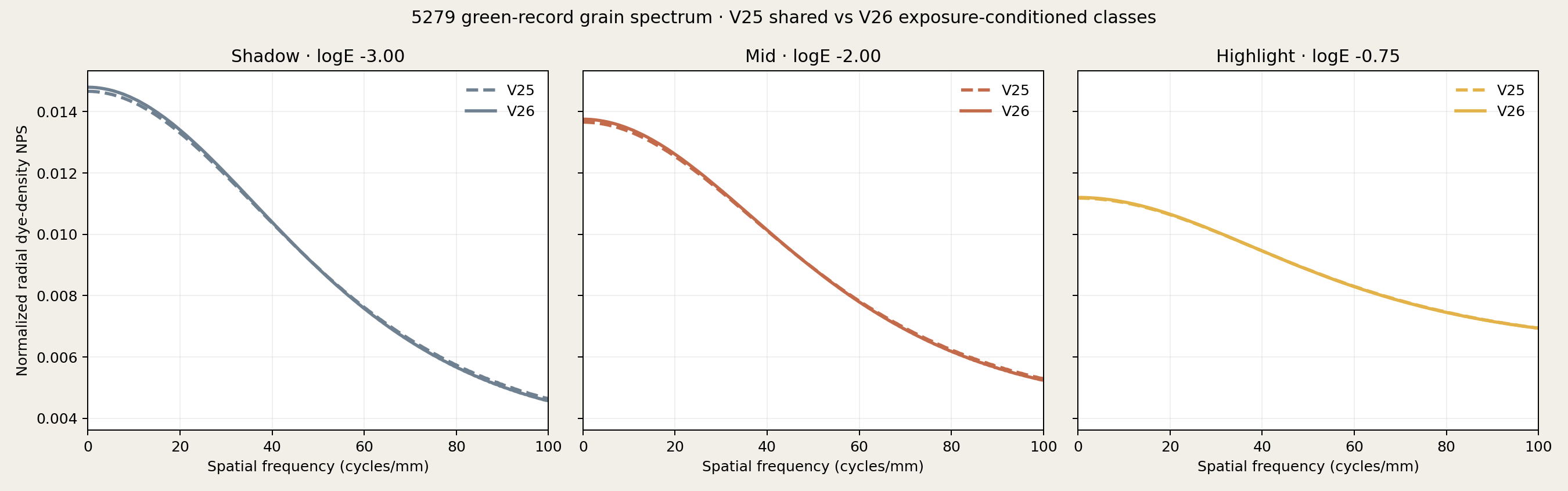
Fast, medium and slow populations receive distinct five-class cloud distributions. Exposure determines which population supplies local variance; the published 5279 RMS determines the integrated amplitude. Colour, tone, MTF, DIR and both observers remained V25.
The green veil was a real density-dependent scanner calibration error
V26 balanced the period scan at 18% gray and one high-density anchor while deliberately retaining 18% of an assumed scanner/dye residual. Neutral diagnostics showed a green hump in shadows and lower midtones, exact neutrality at the single 18% anchor, and a change of bias direction above mid-gray. The web Rec.709→sRGB path and V26 grain were not responsible.
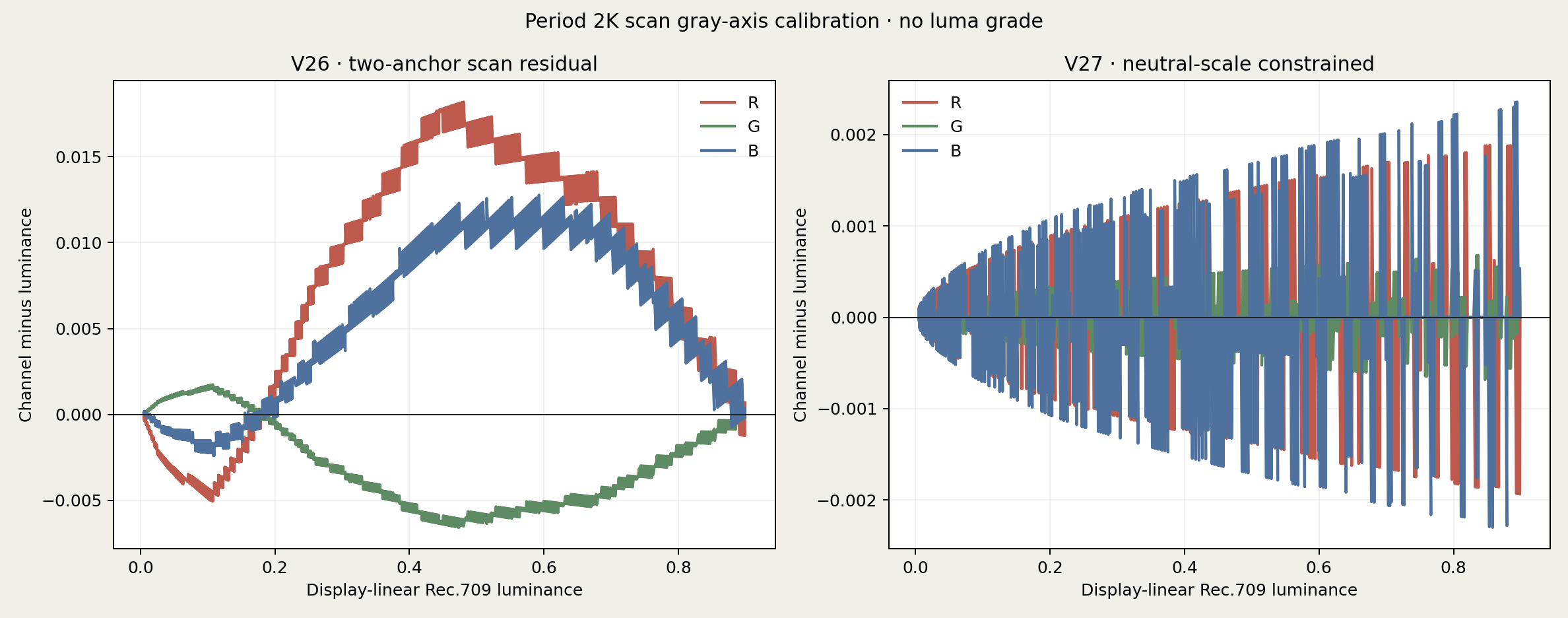
- Green-opponent residualMaximum magnitude fell from about 0.0217 to 0.00242 over display-linear Y 0.005–0.90.
- Luminance preservationMaximum numerical drift is below 1.8×10⁻⁷ before output encoding.
- Projection lockThe 2383 projection result is numerically and byte-for-byte the V26 master.
- Rejected alternativeForcing complete primary separation made the real RAW frame greener and brighter, so it was not adopted.
- Hourly boundaryThe certified April 2003 provisional does name 5279 as identifier 3; May 2003 H022 substitutes 5218 and the later patent returns to 5279. This is document-branch drift, not a numerical calibration payload. No new 5279 NPS or DIR coefficient was recovered, so grain and chemistry remain V26.383941
The second green veil came from a misplaced Camera LUT stage
The decoder's Core Video attachments identify its float RGB buffer as extended-linear BT.2020/D65. V27 encoded that already converted RGB as V-Log and then applied Panasonic's RAW-Gamut-to-V-Gamut Camera LUT, effectively asking a nonlinear camera separation to interpret BT.2020 primaries as unseparated RAW Gamut.44454647
- Not a minus-green gradeLift, gamma, gain, saturation and colour temperature remain untouched.
- Two-scene holdoutT020 scan near-neutral G/R falls from 1.04294 to 1.02895; T032 falls from 1.06476 to 1.04777 while retaining its genuine rainy cyan-green source colour.
- Both observers recomputedThe error precedes 5279 exposure, so neither the print nor scan result can reuse V27 pixels.
- Tone boundaryp99–p99.9 luminance is essentially unchanged, no new white clipping appears, and a synthetic uniform gray remains neutral.
- Film lock5279 sensitometry, dyes, DIR, grain NPS, MTF, 2383, Spirit, black and gamma remain V27.
- Lossless accelerationThe 193³ analytical print lattice is hash-validated; decoded RGB48 hashes from both accelerated 12-bit masters are bit-identical to the reference path.
The final 15–20 percent cannot be completed by adding flavour
H-1-5279t directly constrains neutral H-D, MTF and per-record RMS through a 48 µm aperture. It does not disclose a frequency-resolved NPS, the real three-layer recipe, a 5279-specific DIR matrix or Spirit's proprietary spectrum. V29 therefore retains V28 image formation and implements the measurable remainder as complete-motion and delivery validation.178212234353637
- All 165 framesEvery T002 frame passes through the negative, 2383 and Period 2K observers.
- Absolute-frame seedsParallel ranges form new emulsion by source-frame number; boundaries never reset, loop or translate a grain plate.
- Motion gatesBlack, white clipping, high-frequency RMS and successive-frame correlation are checked across the complete source. This is a scene stress test, not a claimed 5279 NPS measurement.
- Bit-exact boundaryFull-master frame 82 is exactly equal to the independent frame-82 probe in decoded RGB48.
- Validation result165/165 frames pass; hard white clipping is zero for both observers, and audio, timecode and Rec.709 1-1-1 signalling are intact.
- Compute resultBoth native-resolution masters took 3113.17 seconds (51m 53.17s) in parallel, or 18.87 seconds per source frame.
- Next evidenceReplacing the remaining priors requires paired 5279/GH7 spectral charts, neutral/separation wedges, controlled ECN-2 and high-resolution scanner data.
The blue-magenta veil was a traceable calibration error, not a projection look
H-61B publishes unequal 2383 LAD aims: 1.09, 1.06 and 1.03 Status-A density for red, green and blue. V29 replaced these with 1/1/1 and gave a vendor D60 LUT plus digitized curve residuals too much authority over final hue. V30 restores the official channel aims and sets both unsupported hue/saturation controls to zero.448
- Three-scene holdoutT002, T020 and T032 each contribute 24 native 5760×4320 12-bit frames to both film observers.
- Camera baselineThe same RAW receives only the necessary linear BT.2020→V-Gamut transform, V-Log encoding and Panasonic's official V-709 LUT—no 5279, 2383, scan or grade.4449
- Neutral validationMean near-neutral projection chroma is 0.00107, 0.00455 and 0.00261; median observer hue difference is 4.80°, 4.99° and 3.95°.
- Highlight boundaryT020/T032 camera baselines have no hard white clipping. About 1.4% of T002's bright sky reaches the V-709 endpoint; that belongs to the official camera view, not the 5279 shoulder.
- Crash auditTwo Python observer threads can concurrently enter Numba's workqueue and trigger SIGABRT. The safe sequential default is pixel-identical in decoded RGB48.50
- ResultAll three projections pass the neutral gate; rainy T032 retains its real cyan-green atmosphere instead of receiving a global magenta correction.
No silver was retained, yet the image read as bleach bypass
Colour development forms dye and metallic-silver images at the same exposed sites, but normal ECN-2 and ECP-2D bleach and fix that silver away. Kodak separately identifies skip bleach, bleach bypass and ENR as special processes that increase contrast, darken shadows and reduce saturation. A normal 5279→2383 baseline should therefore not default to a strong retained-silver character.35152
V30 had no silver term. It expressed scan-referenced colour as C/L and then replaced L with the steeper 2383 neutral curve. Lower print lightness automatically removed absolute chroma while full-resolution luminance texture remained. Across the three matched scenes, V30 projection median chroma was about 12–17% below the scan, p90–p10 luminance span about 27–32% greater, and fine luminance texture about 48–60% stronger—the perceptual discriminator for a mild bleach-bypass result.
- Texture locked5279 grain, DIR, MTF, black, gamma, 2383 lightness and projection texture remain V30; 98.9–99.2% of fine luma texture is retained.
- ValidationProjection/scan chroma retention is 91.1%, 93.3% and 89.2%; chroma saturation is 103.5%, 96.7% and 96.6%. All scan-master SHA-256 values are identical to V30.
- Error recordTwo earlier placements were bypassed by the hybrid branch and grain-mean stage and were rejected before release. The final correction runs after both complete observers.
- Separate future toggleAny future bypass variant must explicitly model residual silver density—not fake it with global contrast and saturation controls.
Ten hourly notes changed the evidence boundary—not the production model
Hourly research was paused on 4 August 2026. Ten narrowly scoped notes audited DIR, ECN-2 controls, grain measurement, JVT document history and the patent-archive route. None supplied a new 5279 parameter that can be safely implemented, so the V27 production baseline remains unchanged.
What the records support
- Kodak’s DIR diffusion factor is a compound assay, not a fixed 5279 cross-layer constant.
- Green-only ECN-2 exposure is a causal exclusion control, not a transferable interimage coefficient.
- The April 2003 provisional labels identifier 3 as 5279; May’s JVT-H022 labels it 5218. The document branch did drift.
- The US 7,899,113 family was assigned by Thomson to Dolby effective at the end of 2016.343538394143
What cannot be claimed
- H-24 process alarm/action limits are not measurement uncertainty.
- One or finitely many 48 µm aperture RMS values cannot non-parametrically identify a continuous NPS.
- A 5279 label or JVT model_id is not a published parameter table, LUT or grain spectrum.
- Patent ownership does not establish custody of research mail, LUTs or lab records.3637384043
What public records still omit
- The actual 5279 DIR compounds, placement, reaction–diffusion kinetics and cross-layer matrix.
- A complete 5279 NPS, fast/mid/slow sublayer size distributions and physical scale.
- Why the JVT example changed from 5279 to 5218 between April and May 2003.
- The located public JVT mail evidence stops in 2002; Dolby custody of PU030116 working records is unproven.4243
The audit prevents patent examples, control limits and identifier history from being mistaken for a secret 5279 formula.
Falsifiable next evidence: frequency-resolved 5279 grain measurements, same-batch neutral/separation ECN-2 density pairs, or a contemporaneous PU030116 attachment with measurement metadata could test the NPS, interimage and stock-mapping hypotheses. Production parameters remain locked until such evidence exists.
What is known—and what remains unknowable
- Direct: published 5279 sensitometry, diffuse RMS granularity, MTF, sensitivity and net dye-density plots.
- Mechanistic: same-era Kodak multilayer, masking, DIR, ECN-2 and electronic-transfer documentation.
- Still inferred: actual 5279 per-sublayer size distributions, full Wiener/NPS curves, coating amounts, DIR compounds, diffusion constants and proprietary Spirit calibration.
- Not recoverable from RGB: original scene spectra, lens spectral transmission and chemical batch state.
The model seeks a measurement-constrained physical approximation. It does not claim to recover Kodak’s undisclosed formula.
Not prettier noise: complex, heterogeneous finite-grain organization
A read-only audit of the locally installed Nik Collection 8 engine and resources confirms that every B&W stock maps to a separate measured texture. Tri-X 400, T-Max 100 and T-Max 400 have distinct spatial correlation, skew and kurtosis. An inverse-binomial CDF turns pixel density p into a finite-grain realization instead of adding noise to finished RGB.636465
V47 then performs a controlled black-box measurement through the application UI: a 2048-square 16-bit flat-field probe is exported with Kodak Tri-X 400, Intensity 100 and Grain Size 1. Across sixteen tones, measured lag-1 is near 0.38, skew is roughly 0.09–0.15, excess kurtosis roughly 0.17–0.37, and midtone RMS is 0.014309. The first candidate matched RMS and lag but was stopped during its 24-frame render because formed-density kurtosis remained near zero. Accepted SHM measures 0.014315 midtone RMS, shadow/mid/highlight lag-1 of 0.3795/0.3860/0.3914, and excess kurtosis of 0.3034/0.2809/0.2610 while retaining local spectral variation. An explicit kurtosis gate prevents ordinary correlated Gaussian noise from passing on strength and radius alone.
This is not promoted to a 5279 material measurement. Silver Efex is a monochrome still product and cannot identify 5279 cross-record covariance, pre-DIR sublayer randomness or motion-picture temporal law. V46 remains the physical 5279 branch; V47 SHM is an independent, removable same-class morphology comparator on the same deterministic projection and scan observers.12558636572
FSD is an independent finite-density route—not a replacement for physical 5279
The local Silver Efex audit revealed a testable image-formation architecture: a finite count of binary sites is converted to density through an inverse-binomial CDF and blended by an explicit endpoint taper. V40 reconstructs that architecture as Finite-Site Density (FSD), without copying a B&W stock texture or merging it into the three-record 5279 emulsion.636465
Calibrated on one T031 frame only, FSD versus the no-grain baseline has luma RMS 0.01820 against 0.01836 for physical V40, 99.9th-percentile absolute residual 0.10489 against 0.10032, and horizontal/vertical lag-1 0.43808/0.43831 against 0.43339/0.44406. Opponent-colour residual is deliberately lower—0.00152 against 0.00427—because FSD does not claim to reproduce three 5279 colour records or interlayer chemistry. T002 and T007 remain holdouts.
- Physical 5279V40 three records, fast/mid/slow populations, DIR, MTF, published 48 µm RMS and complete observers.
- FSDAn independent test of finite sites forming density—not additive noise and not a claimed 5279 recipe.
- Withdrawn implementationThe first version formed FSD in linear-RGB luma and scaled chroma at random gamut boundaries; sRGB encoding turned that into dark coloured impulses. The corrected version limits signal-density excursion only. Both isolated-spike levels are zero on the strongest T002 single-frame probe, without blur or desaturation.
- Deterministic no-grainThe same RAW, colour, black, gamma and 2383 observer with stochastic sites replaced by expected density.
- Failure gateThe inverse CDF accepts open-interval random values only, preventing the rare giant impulses caused by u=1; every frame is checked for primary spikes, tails and still/video identity.
The chart rejects a shared green error—and exposes five finer boundaries
T003 is 5760×4320 ProRes RAW HQ; its metadata records the GH7, ISO 500 and fixed 5500 K. The target at frame 160 is identified as a DGK Color Tools DKC-Pro 5×7 and sampled against the manufacturer's published 18-patch CIELAB references. Patches 2–4, which the manufacturer recommends for RAW white balance, average R/G=1.175 and B/G=0.745 in Apple's standard extended-linear BT.2020/D65 decode. Their individual ratios span 1.91% and 1.20%. This is a stable warm as-shot direction, not an exposure-dependent green RAW error or missing file white-balance metadata.454766
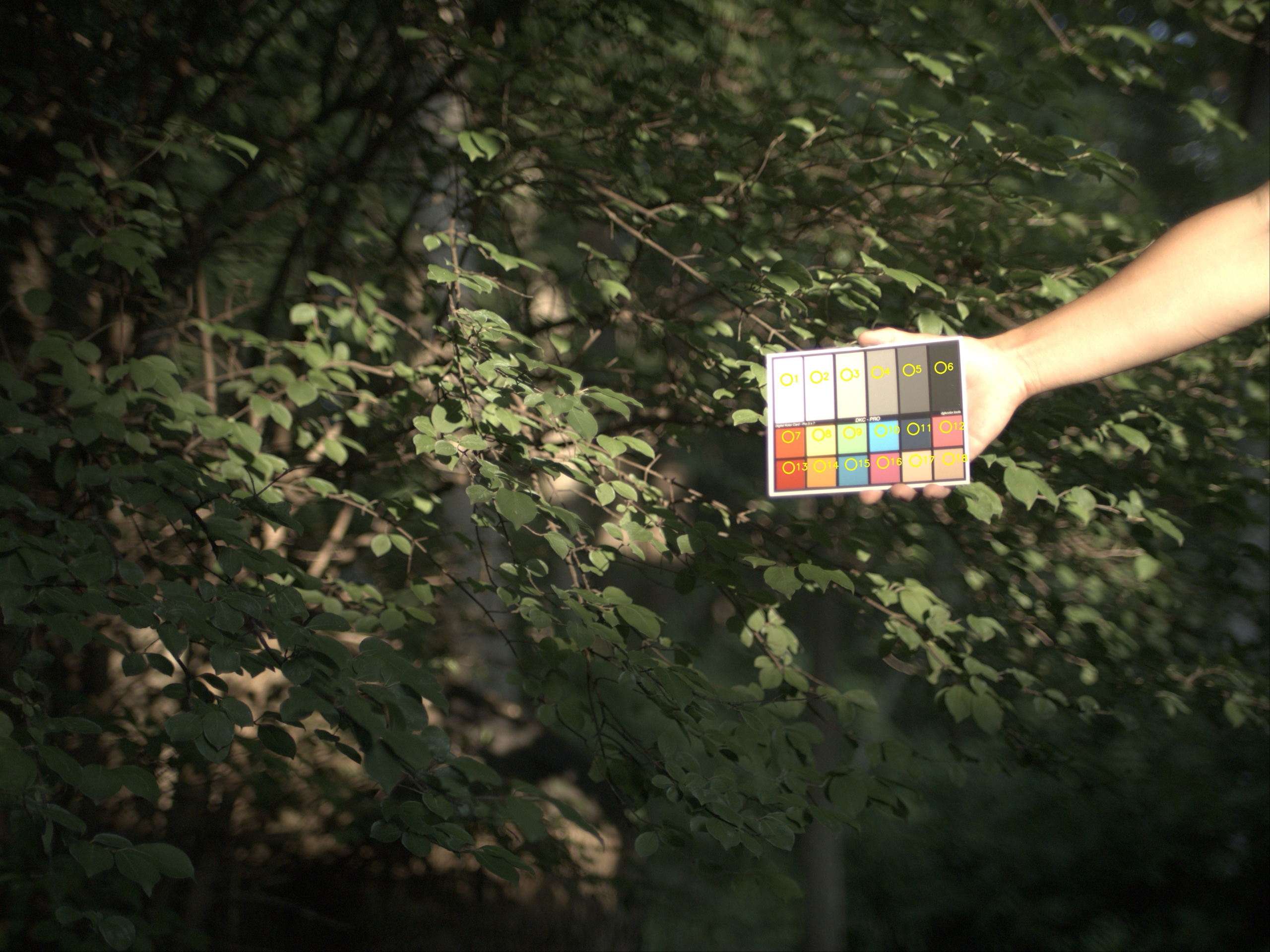
- Gamma is still unidentifiableMeasured Y/reference Y across patches 2–5 spans 0.318 stops, but patch lightness is perfectly tied to left-to-right position. Illumination/reflection gradient and input nonlinearity cannot be separated, so the fitted 1.143 log slope must not enter the pipeline. Optical-flow tracking at seven times from frame 80 to 200 keeps the slope at 1.137–1.147 and the span at 0.304–0.323 stops: this rejects a one-frame accident but not the spatial confound.
- This chart cannot calibrate blackThe manufacturer's patch 6 reference is L*=23, not a zero-reflectance black trap. Its value includes real reflectance, ambient light and lens flare, so it cannot determine sensor offset or the finished-film black pedestal.
- The highlight boundary is locatedAll three RAW white-patch channels exceed 1 and are not clamped at the display endpoint; only one channel of patch 1 reaches the official Panasonic V-709 endpoint. This limit belongs to the camera display witness—not RAW→5279 input.
- Saturated cyan reaches a gamut boundaryPatch 10 creates a −0.01524 red component in the Rec.709-like film-light basis. The three combined 5279 record exposures would all remain positive, but V40 clips the basis first, raising the first record by 19.29% and moving scan/projection chromaticity by about Δu′v′ 0.00226/0.00203. This is a real pipeline boundary—not a RAW clip—and must be tested separately from V39's rejected stochastic model.
- The input matrix remains a testable boundaryDKC-Pro rows are not equal height and a printed title strip precedes the middle row; the first equal-grid audit contaminated patches 7–12 and is withdrawn. With corrected sampling and an explicitly diagnostic D50/Bradford assumption, median hue error is 10.69° for saturated primaries and 7.75° for natural colours. Cross-group 3×3 tests reach median errors of 5.30° and 6.69°. An input-matrix residual is therefore plausible, but unknown scene SPD and reference-Lab conditions still cannot justify a production matrix.
The DGK guide does not state the measurement illuminant/observer for its Lab triplets, and this frame contains directional daylight, target angle and surface reflection. V40 therefore adds no global magenta trim, automatic white balance, black offset or new camera matrix. The evidence supports a narrower conclusion: no fixed green cast is shared across the clips, and As Shot remains the default. The decisive retest is fixed exposure under uniform D65 and tungsten light, shooting both normal and 180-degree chart orientation plus brackets, plus a capped-lens/dark-trap capture: a slope that flips spatially is illumination; one that remains tied to reflectance triggers RAW-linearity and input-matrix audits.
No shared neutral-green crossover, but warm offsets change with exposure
After the corrected patches 2–5 pass through deterministic Period 2K and normal 2383, their chromaticity spread grows to 1.75× and 1.57× the input. Two four-level synthetic ramps remove the outdoor illumination gradient while keeping chromaticity exactly constant.
- D65-neutral ramp passesMaximum Δu′v′ is only 0.000174 in scan and 0.000155 in projection; the pipeline does not manufacture a shared neutral-to-green crossover.
- Constant warm ramp crosses with exposureThe same warm chromaticity reaches maximum Δu′v′ 0.002530 in scan and 0.002204 in projection; brightest-to-darkest distances are 0.004294 and 0.003620.
- Evidence boundaryA three-record negative can reproduce off-neutral colour nonlinearly, so the existence of this effect is not automatically an error. Its current magnitude is model-derived and lacks a matched controlled 5279 measurement.
No grade or global matrix is used to hide it. The next test needs controlled D65/tungsten light, matched GH7 and same-batch 5279 exposure ramps, and high-resolution scans to measure the real off-neutral crossover.
A probable saturation error can be approached without pretending one shoot is a camera profile
T003 reports median chroma ratios of about 0.663 for synthetic colours and 0.923 for natural colours. The closer T005 is mildly defocused, but its larger safe patch interiors independently repeat 0.661 and 0.935. Defocus weakens edges, not the median RGB of a broad interior. Local glare and directional daylight remain the limiting terms, so T005 is a holdout—not a second fitting weight.
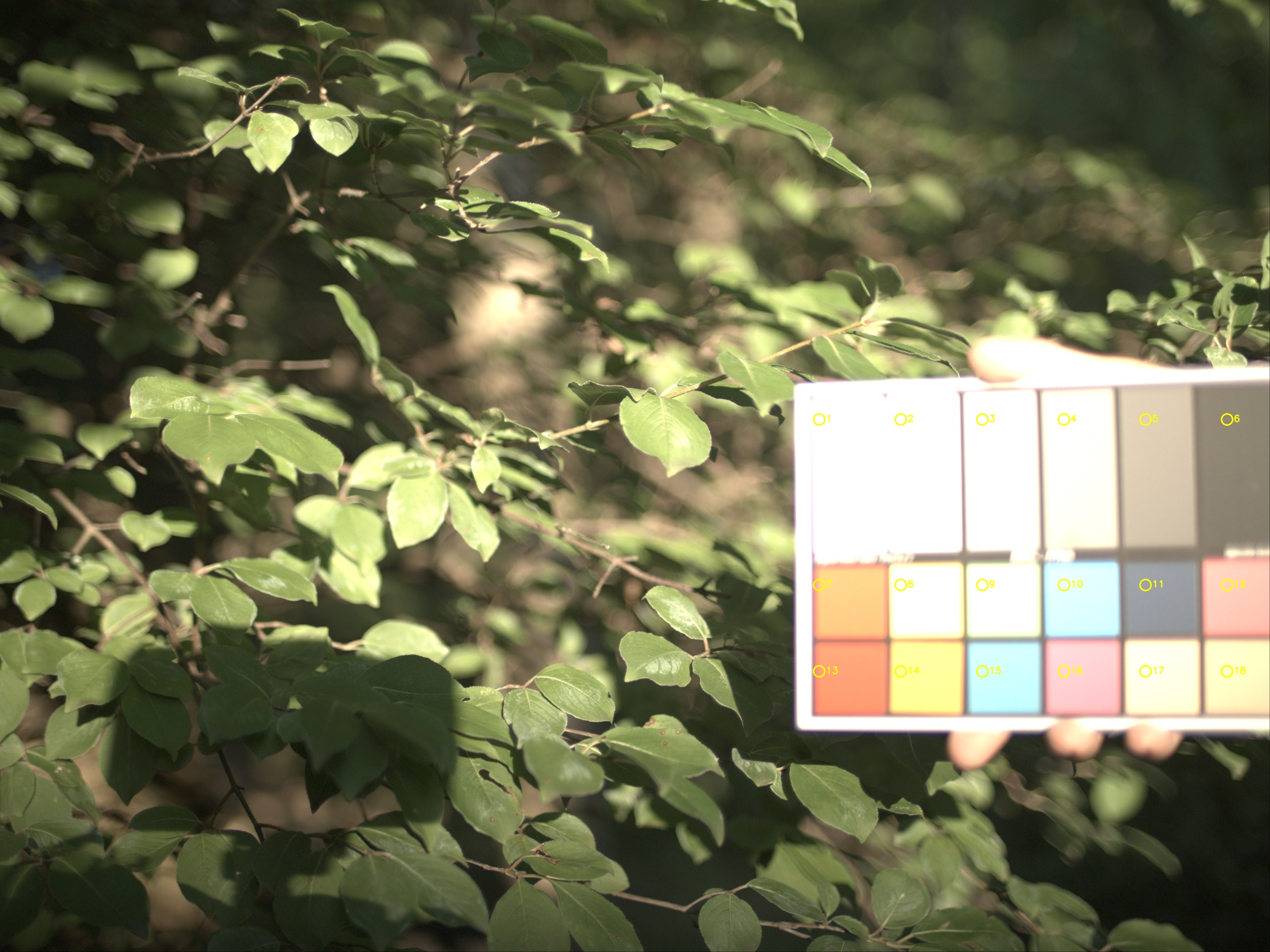
- Cross-group evidenceFit synthetic colours and test natural colours, then reverse the groups and average. T005 never enters matrix estimation.
- Both clips improveT003 synthetic/natural median hue errors move 10.69°→8.98° and 7.75°→6.97°; T005 moves 9.49°→7.79° and 5.52°→4.67°.
- 100% rejectedThe numerically stronger chart fit visibly over-corrects real foliage and yellow patches after the negative and 2383 nonlinearities.
- 25% rejectedIt still raises final 2383 median chroma by about 15%, beyond what two same-condition clips can authorize.
- 12.5% retainedOn T005, final 2383 mean luminance moves only −0.43% while median chroma rises about 7.48%; maximum relative scene-linear luminance change stays below 1e-5.
- Record-safe boundarySigned intermediate film components survive only when every combined 5279 record exposure is non-negative. Unsafe pixels immediately fall back to V40, preventing V39-style nonphysical cancellation.
This does not mean “the GH7 needs 7.5% saturation.” V41 moves a repeated residual a small distance in the supported direction. The remaining 87.5% stays explicitly unknown until uniform D65, tungsten, rotated-chart and exposure-bracket controls exist.